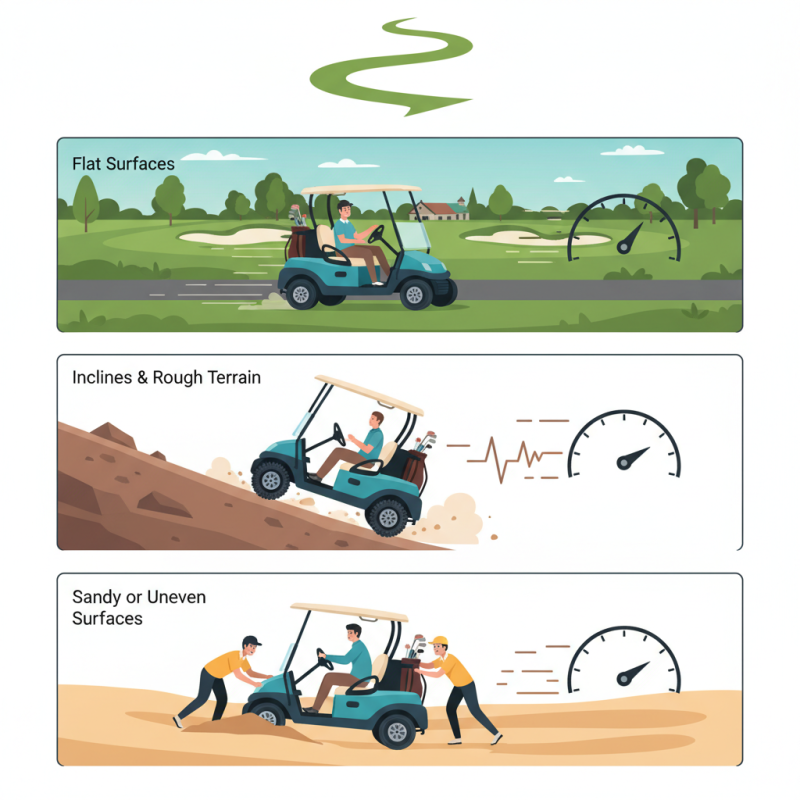
When considering how fast can a golf cart go, it’s essential to understand various terrains. Golf carts are designed for convenience on golf courses, but their speed varies significantly. According to the Association of Independent Golf Industry Professionals, standard golf carts can reach speeds of 12-15 mph on flat surfaces. However, this speed changes drastically on inclines or rough terrain, where power and grip play crucial roles.
A 2021 study published in the Journal of Golf Science revealed that terrain impacts not only speed but also the stability of the cart. For example, on sandy or uneven surfaces, the speed could drop to as low as 5-8 mph. This variability raises important questions about efficiency and design in the industry. As golf courses evolve, understanding how fast can a golf cart go on different terrains becomes crucial for enhancing user experience and safety.
Ultimately, the terrain you traverse determines a lot about the golf cart's performance. While many users expect high speeds on any surface, manufacturers emphasize the importance of terrain-specific adaptations. A golf cart that excels on the course may not perform as well in a rugged landscape. This awareness can help golfers better choose their carts based on travel needs.
Understanding Golf Cart Speed Variations on Different Terrains
Golf carts are popular for their versatility and ease of use on various terrains. Understanding how these vehicles perform on different surfaces can help owners maximize their potential. On flat, paved surfaces, golf carts can reach speeds of up to 20-25 mph. However, gravel paths, sand, or uneven ground can slow them down significantly, often to around 10-15 mph.
For those looking to optimize their cart’s performance, consider these tips. Maintaining proper tire pressure is crucial. Under-inflated tires can create drag, reducing speed and efficiency. Keep the cart clean, as dirt can add unnecessary weight. Lastly, regular maintenance checks can prevent performance issues.
Navigating steep hills presents unique challenges. Speed may drop to 5 mph or less when climbing. In contrast, downhill travel can allow for faster descents. It's essential to control the descent to avoid sudden stops or accidents. Also, using the right mode for the terrain can enhance safety. Always proceed cautiously, especially on difficult ground. Driving a golf cart is a balance between speed and safety, particularly in varied landscapes.
Factors Influencing Golf Cart Speed on Various Surfaces
When evaluating how fast a golf cart can go on various terrains, several factors come into play.
The surface type is one of the most significant influences.
Smooth, paved paths allow for higher speeds, while uneven ground or dirt slows them down.
Golf carts typically reach speeds of 15-25 mph on these surfaces.
But on gravel or sand, the speed can drop to 10 mph or even less.
The weight of the golf cart and the number of passengers also play a role. A heavier cart will struggle on inclines.
Additionally, tire pressure affects traction and speed.
Properly inflated tires will improve performance but can fail on rough terrain if over or underinflated.
Weather conditions add another layer of complexity.
Rain can create slippery surfaces, necessitating slower speeds for safety.
Extreme heat can also impact battery performance in electric carts.
Observing these elements can enhance your understanding of golf cart speeds on different terrains.
However, experiencing the variations firsthand offers invaluable insights that data alone cannot provide.
Performance of Golf Carts on Flat vs. Inclined Terrain
Golf carts are designed for easy navigation on different terrains, but their performance can vary significantly. On flat ground, these carts can reach their optimal speed of about 15 to 25 mph. The smooth surface allows for more efficient propulsion. Carts glide effortlessly, making short commutes a breeze. In contrast, on inclined terrain, the performance drops. Hills require more power to maintain speed, with many carts unable to exceed 10 mph without bogging down.
Tips: Consider the gradient of your terrain. If you're on a steep incline, opt for a model with higher torque. Lightweight carts may struggle more on hills. If you often drive on uneven surfaces, ensure your tires are well-suited to handle the rough terrain.
Driving on inclines also brings attention to battery life. Speed decreases when batteries drain. Ensuring regular maintenance and checking battery levels can enhance your golf cart's performance. This can prevent unexpected slowdowns when tackling those challenging hills. Always assess your routes and adjust your speed accordingly.
How Fast Can a Golf Cart Go on Different Terrains?
Speed Comparisons: Grass, Sand, Paved Roads, and Off-Road Conditions
Golf carts are designed for various terrains, impacting their speed significantly. On paved roads, a typical golf cart reaches speeds up to 25 mph. This is due to the smooth surface that allows for better traction and less resistance. Reports from the National Golf Cart Association suggest that many models are optimized for urban and golf course environments, making them efficient on these surfaces.
However, on grass, the speed drops. The soft surface absorbs impact, limiting acceleration. Golf carts can manage around 15 mph on well-maintained grass. Uneven or wet grass conditions further reduce speed, making it crucial for operators to adapt their driving style.
Sand presents further challenges. The loose texture slows golf carts to about 10 mph. The lack of stability leads to potential safety concerns. Operators often struggle to maintain control, especially on steep dunes. Off-road conditions, including rocky terrain, exacerbate this issue, as carts can stall or tip over. Understanding these varying speeds and conditions is essential for safe and efficient operation.
How Fast Can a Golf Cart Go on Different Terrains?
| Terrain Type |
Average Speed (mph) |
Top Speed (mph) |
| Grass |
12 |
15 |
| Sand |
8 |
10 |
| Paved Roads |
15 |
20 |
| Off-Road Conditions |
10 |
12 |
Tips for Maximizing Golf Cart Speed Depending on Terrain Type
Golf carts can navigate various terrains, but their speed varies significantly. On smooth asphalt, they might reach 15-25 mph. Conversely, on bumpy trails, the speed can drop to as low as 5-10 mph. Understanding how to maximize speed on different surfaces can enhance the overall experience.
To ensure optimal speed, consider the following tips. First, check tire pressure regularly. Properly inflated tires reduce friction and improve traction. Soft or worn tires can hinder progress. Making sure the cart is well-maintained also plays a crucial role. A clean, well-tuned engine allows for efficient energy use.
Lastly, adjust your driving technique. On inclined surfaces, accelerate gradually. Sudden acceleration may lead to loss of control or damage. Riding with a load can also impact how quickly the cart moves. Be aware of these factors to enhance performance. Familiarize yourself with specific terrain types, as knowledge is key to making the most out of your golf cart experience.
FAQS
: The surface type significantly influences speed. Paved paths allow for higher speeds, while gravel slows them down.
On flat, paved surfaces, golf carts typically reach speeds of 20-25 mph.
Speed often drops to 5 mph or less when climbing steep hills.
Yes, rain creates slippery surfaces, requiring slower speeds for safety. Extreme heat can affect battery performance.
Properly inflated tires reduce drag and improve traction, enhancing speed and efficiency.
Regular cleanliness, maintenance checks, and tire pressure monitoring are essential for optimal speed.
A heavier cart may struggle on inclines, reducing overall speed on varied terrains.
Gradual acceleration on inclines can prevent loss of control or damage to the cart.
Check tire pressure, cleanliness, and overall maintenance to improve performance.
No, always proceed cautiously on uneven ground to avoid accidents. Speed must be balanced with safety.
Conclusion
This article explores the question of how fast can a golf cart go on different terrains, highlighting the variations in speed influenced by surface type. Various factors such as terrain inclination, surface material, and design of the golf cart play a significant role in determining speed. Performance metrics reveal that golf carts can achieve optimal speeds on flat paved roads, while grass, sand, and off-road conditions present unique challenges that typically reduce speed due to varying levels of traction and resistance.
Additionally, the article delves into speed comparisons across different terrains, emphasizing the need for tailored strategies. Understanding how to adjust driving tactics based on terrain—such as maximizing power on inclines or managing speed on soft surfaces—can significantly enhance the overall performance of golf carts. With proper knowledge and techniques, users can better navigate these diverse environments and optimize their golf cart experience.

 Kabar Golf